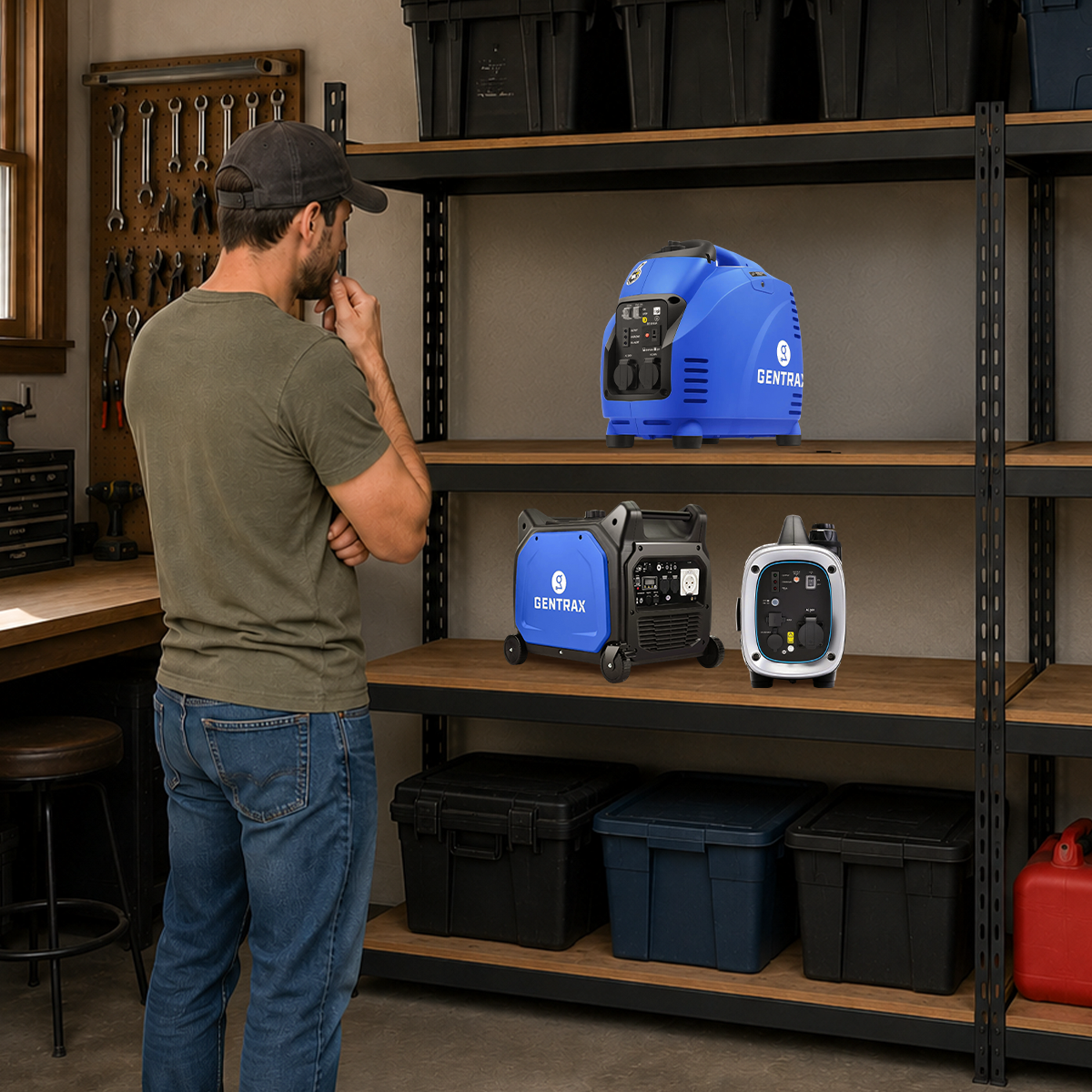
Buying a generator sounds simple until you’re faced with dozens of models, specs, and price points that don’t always make sense. Many first-time buyers focus on price or the biggest power number they can find, only to realise later that the unit is too noisy, underpowered, or unsuited to their needs.
These portable generator buying mistakes can lead to frustration, wasted money, or even safety risks. This portable generator buying guide breaks down the most common pitfalls—from sizing choice to noise, inverter technology, and safety—so you can choose the right generator with confidence.
Mistake 1: Choosing the Wrong Generator Size
One of the most common mistakes is getting the size wrong. Portable generator sizes are typically measured in watts or kVA, but what really matters is whether the generator can handle your actual load.
Every appliance has two requirements: running watts and starting watts. Refrigerators, pumps, and power tools need extra power to start, which is where many generators fall short. This is why simply asking “What size portable generator do I need?” isn’t enough. You need to look at how your appliances behave, not just their labels.
A generator that’s too small will overload and shut down. One that’s too large will burn more fuel than necessary and cost more upfront. The practical approach is to list essential appliances first, then estimate total demand. A generator wattage calculator can help, but it’s still best to check appliance ratings yourself.
Mistake 2: Confusing kVA, kW, and Wattage
Another common issue is misunderstanding power ratings. You’ll often see terms like watts, kilowatts (kW), and kVA used interchangeably, but they’re not exactly the same.
Watts and kilowatts measure real power—what you actually use. KVA, on the other hand, measures apparent power, which includes inefficiencies in the system. This is why generator kVA vs kW can be confusing for beginners.
For most buyers, wattage is the more useful number because appliances are rated in watts. The key is to compare a generator’s rated (continuous) output and peak (starting) output, rather than focusing on the biggest number in the product title. This becomes especially important for appliances like refrigerators, air conditioners, and tools that require extra startup power.
Mistake 3: Generator Not Matching the Main Use Case
Not all generators are built for the same purpose. A portable generator for home has different requirements compared to a portable generator for camping.
For home backup, the priority is to keep essentials running, often for extended periods. For camping or caravanning, portability, fuel efficiency, and low noise matter more than raw power. Worksites and outdoor use bring another set of needs, including higher wattage and durability for tools.
Buying a generator designed for one purpose and expecting it to perform well in every scenario is a common mistake. This is where having a clear use case matters. Brands like Gentrax design portable inverter generator options across different sizes, making it easier to match the generator to how it will actually be used, whether that’s weekend camping or reliable home backup.
Mistake 4: Ignoring Fuel Type
Fuel choice plays a bigger role than most people think. Portable generator fuel affects running cost, convenience, and long-term usability.
A portable petrol generator is the most common option. It’s easy to refuel, widely available, and suits most home backup and camping scenarios. For many users, it strikes the best balance between convenience and performance.
A portable diesel generator, on the other hand, is typically used for heavier-duty or long-running applications. It can be more fuel-efficient under load, but it’s often heavier, noisier, and more expensive upfront.
Choosing between petrol and diesel shouldn’t come down to price alone. Think about how often the generator will be used, where fuel will be stored, and how easy it is to refuel when needed.
Mistake 5: Underestimating Noise Levels
Noise is one of the most overlooked factors until the generator is actually running. A quiet portable generator makes a significant difference, especially in campsites, caravans, or residential areas. A loud unit can quickly become disruptive, particularly during overnight use or in shared environments.
Most manufacturers list noise levels in decibels (dB), usually measured at a set distance. Lower numbers mean quieter operation, but keep in mind that noise often increases under heavier loads. A low noise portable generator is especially important for camping and home use, and this is where inverter models often stand out due to their quieter operation and variable engine speeds.
Mistake 6: Overlooking Inverter Generator Technology
Not all generators produce the same quality of power. An inverter generator is designed to deliver stable, consistent electricity suitable for modern electronics.
Unlike many conventional generators, inverter models produce cleaner output. A pure sine wave inverter generator closely matches the power supplied by the grid, making it safer for devices like laptops, phones, TVs, routers, and battery chargers.
This matters more than ever as households rely on sensitive electronics. Poor-quality power can cause damage or reduce the lifespan of devices. Gentrax’s range of inverter generators is built around this principle, offering pure sine wave output for users who need reliable, clean power for both everyday and emergency use.
Mistake 7: Treating Safety as an Afterthought
Portable generator safety starts at the point of purchase, not after unboxing. Many buyers focus entirely on wattage and prices without checking what built-in safety features the unit includes.
Look for generators with overload protection, low-oil automatic shut-off, and circuit breakers as standard. These features help prevent damage to the unit and reduce risk during everyday use. It’s also worth checking whether the generator meets current Australian safety and compliance standards before committing to a purchase.
Buyers should also consider how the generator will be used in practice. If it will run near a campsite, caravan, or home, think about safe placement, ventilation, and whether you need a transfer switch for household connection. Choosing the right extension cords and understanding load limits are also decisions best made before you buy, not figured out on the fly.
Mistake 8: Buying Based Only on Price
Price is often the deciding factor, but honestly? It shouldn’t be the only one. Cheaper generators can cost more over time through higher fuel consumption, excessive noise, and lower reliability. They may also lack proper support or spare parts availability.
A better approach is to look at overall value: runtime, fuel efficiency, build quality, warranty, portability, and after-sales support. The best generator isn’t the cheapest or the most powerful, but the one that fits your actual needs.
Portable Generator Buying Checklist
Still wondering how to buy a portable generator without regretting anything? Run through this quick checklist before deciding:
- Calculate total appliance wattage, including starting loads.
- Compare rated output vs peak output (not just the biggest number).
- Understand generator kVA vs kW and focus on usable wattage.
- Choose the right size based on your main use (home, camping, or tools).
- Pick a suitable fuel type.
- Check the runtime and fuel efficiency.
- Review the noise level, especially if you need a quiet portable generator.
- Consider a portable inverter generator for cleaner, stable power.
- Look for a pure sine wave inverter generator output if using sensitive electronics.
- Confirm key safety features (overload protection, low oil shut-off, circuit breakers).
- Ensure proper outdoor use and safe setup.
- Compare warranty, portability, and after-sales support.
Buy Smart, Power Smarter
Avoiding the common portable generator buying mistakes comes down to understanding what actually matters: size, power type, fuel, noise, safety, and real-world use.
A well-chosen generator should be reliable, efficient, and suited to how it will be used, not just what looks good on paper. By following a clear portable generator buying guide, buyers can avoid costly errors and invest in a solution that delivers long-term value.
For those ready to compare options, Gentrax offers a range of portable inverter generator models designed for home backup, camping, outdoor work, and emergency power—built to deliver dependable performance when it matters most.
Frequently Asked Questions
What size portable generator do I need?
It depends on what you want to power. Add up the wattage of your essential appliances, including startup (surge) power for items like fridges or pumps. For basic camping, 1 kW to 2 kW may be enough, while home backup often requires 2 kW to 5 kW or more.
Is a portable petrol generator better than a portable diesel generator?
Neither is universally better. It depends on your needs. Petrol generators are typically lighter, quieter, and cheaper upfront, making them good for occasional or light use. Diesel generators are more fuel-efficient, longer-lasting, and better-suited for heavy or prolonged use, but they tend to be heavier, noisier, and cost more initially.
Is a quiet portable generator worth it?
Yes, especially for camping, caravanning, or residential areas where noise matters. Quiet inverter generators are more comfortable to use and less disruptive to others. They’re also often more fuel-efficient and suitable for sensitive electronics.
What is a pure sine wave inverter generator?
It’s a generator that produces clean, stable electricity similar to what comes from a household outlet. This makes it safe for sensitive electronics like laptops, phones, and medical devices. It also helps prevent damage or interference in delicate equipment.
Can I use a portable generator for home backup?
Yes, portable generators are commonly used for home backup during outages. They can power essential appliances like fridges, lights, and small electronics. For a safe connection to your home’s wiring, a transfer switch installed by an electrician is recommended.
